Starship is the central bottleneck
Many future plans depend on high launch frequency, full reusability and much lower costs. Delays would hit Starlink, lunar projects and orbital computing at the same time.
Company valuation | Data as of 29 May 2026
At an expected IPO price of $135, the valuation already assumes that Starlink, Starship, xAI and orbital computing will all work almost at once.
My conclusion first
$135 is not a fair entry price for me. At an expected valuation of roughly $1.75 trillion, that is about 94 times 2025 revenue even though SpaceX was loss-making both operationally and overall. The market is valuing the company as if the next ten years pass without major disappointment.
The actual numbers
SpaceX generated $18.674 billion of revenue in 2025. Connectivity around Starlink contributed $11.387 billion and $4.423 billion of operating profit, making it the more profitable part of the business.
The AI segment generated $3.201 billion of revenue but recorded an operating loss of $6.355 billion. SpaceX reported an operating loss of $2.589 billion and a net loss of $4.937 billion for 2025. In Q1 2026, another $4.276 billion net loss followed on $4.694 billion of revenue, while investment alone reached $10.107 billion.
SpaceX is funding Starship, new satellites, data centres, GPUs and xAI at the same time. Revenue alone does not show that capital commitment or the losses.
My DCF valuation
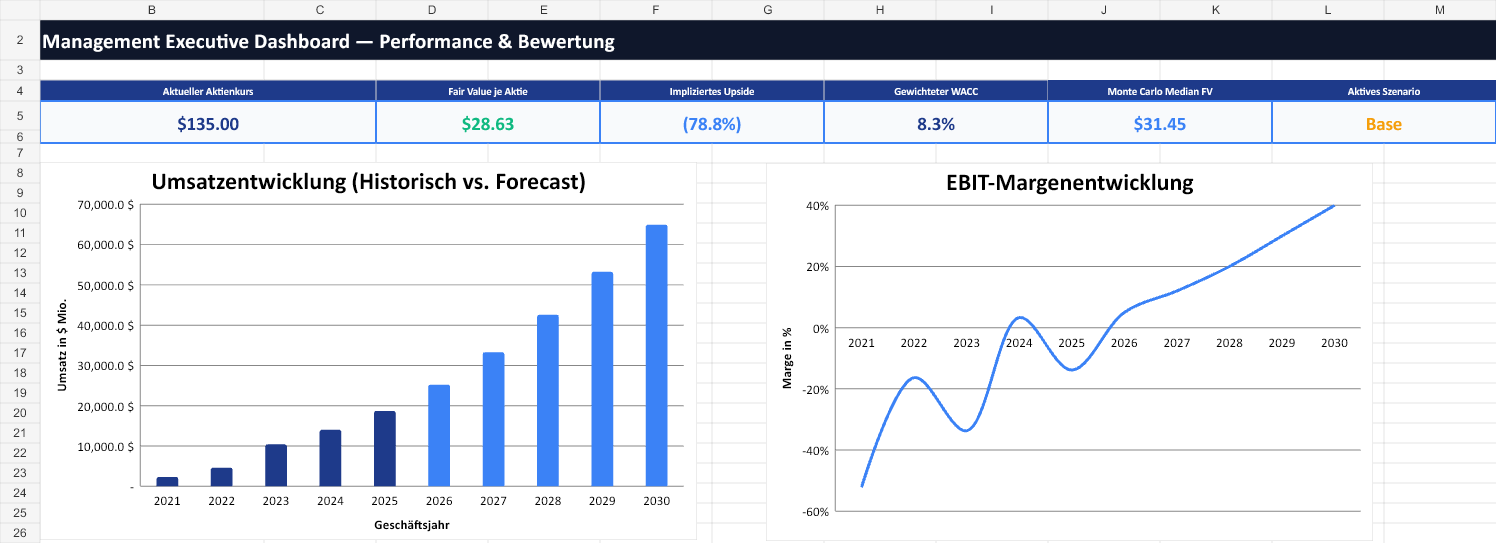
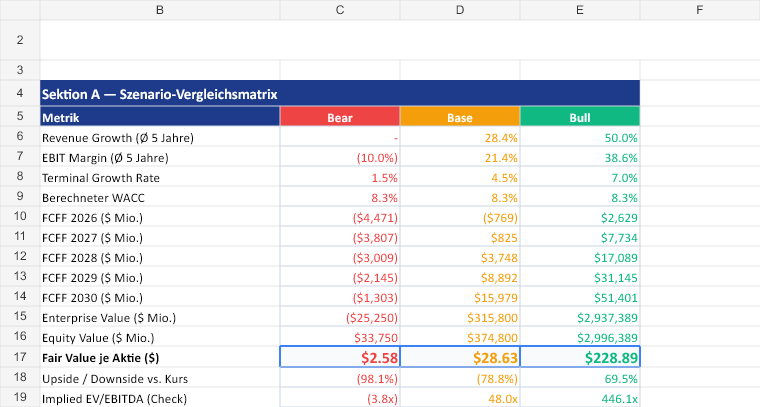
I used my own DCF tool. Even the base case is not conservative: five-year average revenue growth of 28.4%, an EBIT margin of 40% in 2030 and perpetual growth of 4.5%. Those are already very optimistic assumptions.
The fair value still comes to only $28.63 per share, roughly 78.8% below $135. The bear case is $2.58. Only the extremely optimistic bull case reaches $228.89.
The bull case requires average revenue growth of 50%, sharply rising margins and a very high terminal growth rate. It may happen, but it is not an assumption I would use to justify a normal entry price.
Why the valuation is dangerous
New Constructs reaches a similar problem with its reverse DCF. Even with 34% annual revenue growth through 2035 and an immediate NOPAT margin of 19%, that analysis puts enterprise value at about $500 billion, roughly 71% below the expected $1.75 trillion.
Many future plans depend on high launch frequency, full reusability and much lower costs. Delays would hit Starlink, lunar projects and orbital computing at the same time.
The AI segment is losing billions while competing with companies that already have major customer relationships and enormous computing capacity.
Stock compensation, new funding rounds and performance-based share packages can materially dilute today's shareholders.
The voting structure gives Musk roughly 85% of the votes. Public shareholders carry the economic risk with little influence.
One customer represented 21% of revenue in 2025. Government contracts are valuable but can be cut, delayed or ended for political reasons.
The S-1 reports substantial debt, rising investment and reporting controls that were not yet fully established. At this valuation there is little room for error.
Lock-up periods
Only comparatively few shares are expected to trade freely at launch. That can support the price in the short term when demand meets limited supply. As more shares are released, the effect can reverse. SpaceX is not using one simple 180-day lock-up.
Up to 20% of eligible insider shares may be sold shortly after the first quarterly report as a public company.
Another 10% may be released early if the share trades well above the IPO price. A strong price can therefore attract additional sellers.
Further tranches are released gradually; the regular block is unlocked after 180 days at the latest.
Musk himself has a longer 366-day lock-up. That does not prevent sales by employees, early investors and other insiders.
No holder has to sell after release. Still, selling pressure is realistic: employees and early investors have held shares for years and may liquidate part of their wealth. Later price action depends on how many new shares meet the IPO buyers.
Model and tool
The full SpaceX valuation contains bear, base and bull cases, WACC, DCF, sensitivity, Monte Carlo and peer multiples. If you consider other growth or margin assumptions more realistic, edit the blue input cells directly.
Read next
Sources as of 29 May 2026
Note: As of 29 May 2026, the final IPO price had not been officially set. This model uses $135 as the expected price anchor, matching the reported target valuation of about $1.75 trillion at that time. It is a personal model based on the data available then, not investment advice.